

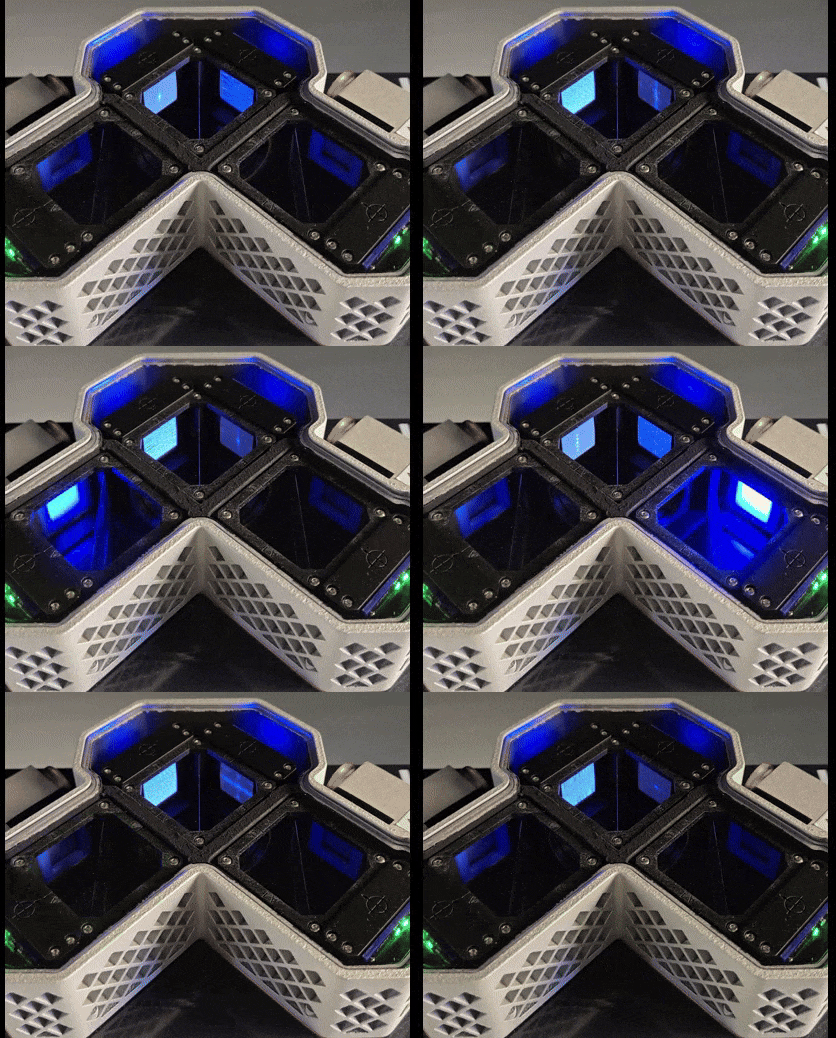
Unlike current Artificial Intelligence implementations using digital spatial convolutions, Look Dynamics’ Photonic Neural Net (PNN) harnesses the ultimate parallelism of photons using optical Fourier transforms to enable processing of any digital data normally processed by CNNs. It offers much higher speed and power efficiency than even the fastest GPUs or custom Neural Network ASICs.
The PNN supports all existing CNN architectures and training methods. Except for the fact that they are calculated in a photonic Fourier space and are inherently more accurate, the convolutions are the same as those computed by traditional digital methods. Dedicated on-chip circuitry supports pooling, ReLU, thresholds, deconvolution flags and all other linear and non-linear operations to fully implement any AI architecture. Nothing to change and nothing to learn.
But there is more.
In addition to convolutions, the PNN is built on a silicon analog array device that implements super-speed array operations, combining nearly instantaneous processing with next-generation permutational algorithms to implement a wide variety of algorithms including Large Language Models, Transformers, SVM, RNN, CNN, Diffusion, and more. All can be configured on-the-fly.
The key differences between Look’s technology and current digital approaches are greatly improved speed, power, size, and latency. Reflecting a data plane off of a modulator is the fastest possible way to calculate a array operations including convolution, giving the PNN full resolution parallelism at the speed of light. Combined with its analog array architecture, where every data element is retained on-chip in the ideal location for the next stage, it is nearly 100% efficient.